Austin McDaniel · Jun 4, 2026
A few weeks ago someone sent me a link to their new startup and asked what I thought. Easy enough. I pasted it into Claude and asked for a few talking points before I replied.
Claude told me the site didn't render anything. No content. Nothing to review.
So I opened the link myself. The site loaded fine. Looked good, actually — clean, modern, the works. Then I did the thing I always do and hit View Source.
Empty div.
The entire site — every headline, every value prop, every carefully prompted line of copy — was being assembled by JavaScript at runtime, after the page loaded, invisible to anything that wasn't a human sitting in front of a browser. Including, as it turns out, the AI that half the planet now uses to evaluate vendors before a human ever clicks the link.
That's the part of "you don't need a designer anymore" nobody screenshots for LinkedIn.
I want to be clear up front, because this is going to read like a rant otherwise: I think Claude Design and Claude Code are genuinely amazing. If you want a personal site, a portfolio, a landing page for your weekend project — go nuts. It is the single best thing to happen to people who hate building websites since templates. This post is not "AI bad."
This post is for the company with actual capital, reading influencer takes about firing their design team, about to make your homepage a one-shot prompt. Because the front door of a business is a different animal, and the shortcut has a bill attached that doesn't show up until later.
The part the influencers get right
Let's give the hype its due, because most of it is true.
It's fast. You can go from nothing to a genuinely good enough looking website in a handful of prompts. Not "good enough for a hackathon" — good enough that a normal person would not blink. That was science fiction three years ago.
It's cheap. The cost is a subscription you might already have. Compared to a Webflow template you're still better off, and compared to a $40K agency engagement it's a rounding error.
It can write. I have a joke I trot out constantly: designing a website is easy, it's the content that's hard. AI is shockingly good at filling in the blanks — and that's the trap, so read the next sentence twice. It is good at content if you give it a storyline and make it stay on it. Hand it a narrative and hold the line and you'll get copy you can ship. YOLO it and you'll get pages of confident, polished, professional-sounding sentences that, on the third read, mean absolutely nothing. Buzzword soup with great kerning.
So yes. Fast, cheap, articulate. Now let's talk about the invoice.
The part where the bill comes due.
It looks like AI made it
We are living through a moment where the most common instruction typed into a prompt box is some variation of "don't make this sound like AI." Everyone can smell it now. So ask yourself: do you want the front door of your business to look like it was one-shot prompted? You'll spend thousands putting your logo on a banner at a conference, and then point everyone you meet to a site that looks like the other 400 startups that booth season. When everyone looks the same, the one who doesn't is the one people remember. Sameness is the most expensive thing on this list and it doesn't show up on any invoice.
Maintenance is fine — until you're not the one doing it
Here's the asymmetry nobody mentions. If you're a developer, editing an AI-built site is trivial. You understand the code, you open the file, you change the thing, you're done. I do it constantly.
If you're not a developer, "change this one section" becomes an afternoon. You re-summon Claude, you re-explain context it no longer has, you wrestle it toward the change, you review what it actually did versus what you asked, you redeploy, you test, you discover it quietly rewrote three other things, you go again. A one-line edit becomes a negotiation. Most people don't edit the code because they can't — so they fight the AI for hours and burn tokens instead.
B2B websites need things AI doesn't hand you
A real business site usually needs a blog, a contact form, a CMS so non-engineers can publish without a deploy. AI gives you a beautiful static front-end and a shrug. Now you're custom-coding a form handler or bolting on something like Sanity — which is fine, that's a real job, it's just a real job nobody told the influencer audience about.
Deployment is now your problem
Picking a provider. DNS. CI/CD. SSL. Security. Uptime. The AI built you a website; it did not build you an ops practice. All of that is yours now, and "the homepage is down" is a much worse Tuesday than "the homepage looks a little generic."
SEO and AEO — the empty div again
Back to the startup that didn't exist. A huge share of the sites these tools produce render in the browser at runtime. Humans see a page. Crawlers, scrapers, and increasingly the AI models people use to research you see that empty div. In a world where buyers ask an assistant "is this vendor any good" before they ever load your site, being invisible to the assistant isn't a technical footnote — it's the top of your funnel quietly evaporating.
Accessibility — the thing a first-timer will never check
Someone building their first website does not know WCAG exists, will not think about contrast ratios, keyboard navigation, or screen readers, and — critically — has no way to tell whether the AI actually implemented any of it or just told them it did. For a lot of companies (and basically all of mine, who sell into security and enterprise) that's not a nice-to-have. That's a procurement checkbox and sometimes a lawsuit.
Security and the legal bill
Generated code can quietly do things you'd never sign off on — leak data, mishandle form submissions, ignore consent requirements. CCPA, GDPR, and friends don't care that an AI wrote it. "We didn't know the contact form was doing that" is not a defense anyone enjoys mounting.
So when should you use it?
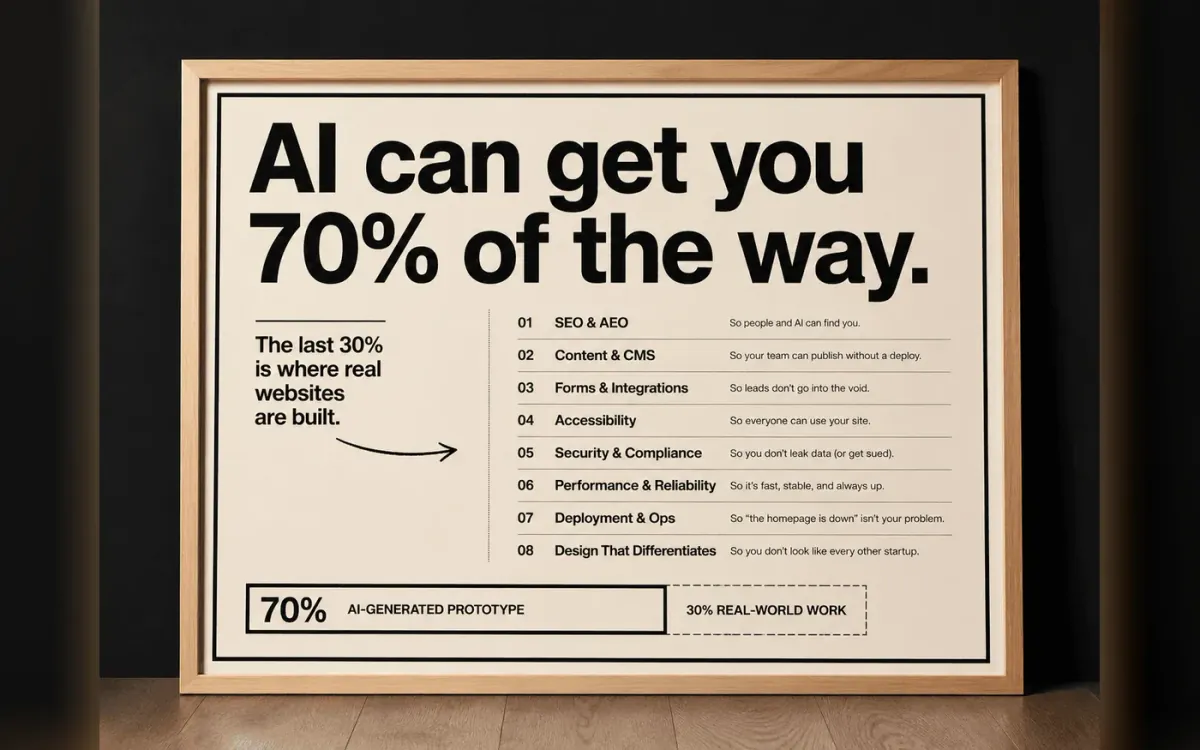
I use it constantly — for prototyping. It's the fastest way I've ever found to get an idea out of my head and onto a screen so I can react to it. But here's the honest part: the prototype almost always needs so much tweaking to be right that I end up in the code editing it by hand. That's the move. AI gets me to 70% in twenty minutes; the last 30% — the part that makes it actually good — is hands on keys.
The catch is that "drop into the code and finish it by hand" is exactly the option most people don't have. Which is the whole point. The tool is incredible at the part that was already easy and leaves you alone for the part that was always hard.
Nothing here is going to beat someone who's been doing this longer than AI has been around.
How we actually do it at Good Code
This isn't a "humans good, robots bad" sermon. We use Claude Design and Claude Code every single day — the difference is they're in the hands of people who've been building this stuff by hand for decades. That combination is the whole pitch: unique designs, at the speed of AI, at a cost below what handmade used to run. We get the prototype to 70% in twenty minutes like everyone else. We're just the ones who can take it the rest of the way — accessibility, SEO/AEO that actually renders, a CMS your marketing team can run without filing a ticket, deployment and security that won't end up in a deposition.
If you've got the capital and you're tempted to make your homepage a weekend prompt, that's genuinely fine — for the weekend project. For the front door of your business, talk to people who'll still be there when you need to change one little section.
That's us. Good Code — design and engineering for companies building the hard stuff.
Now go hit View Source on your own site. I'll wait.